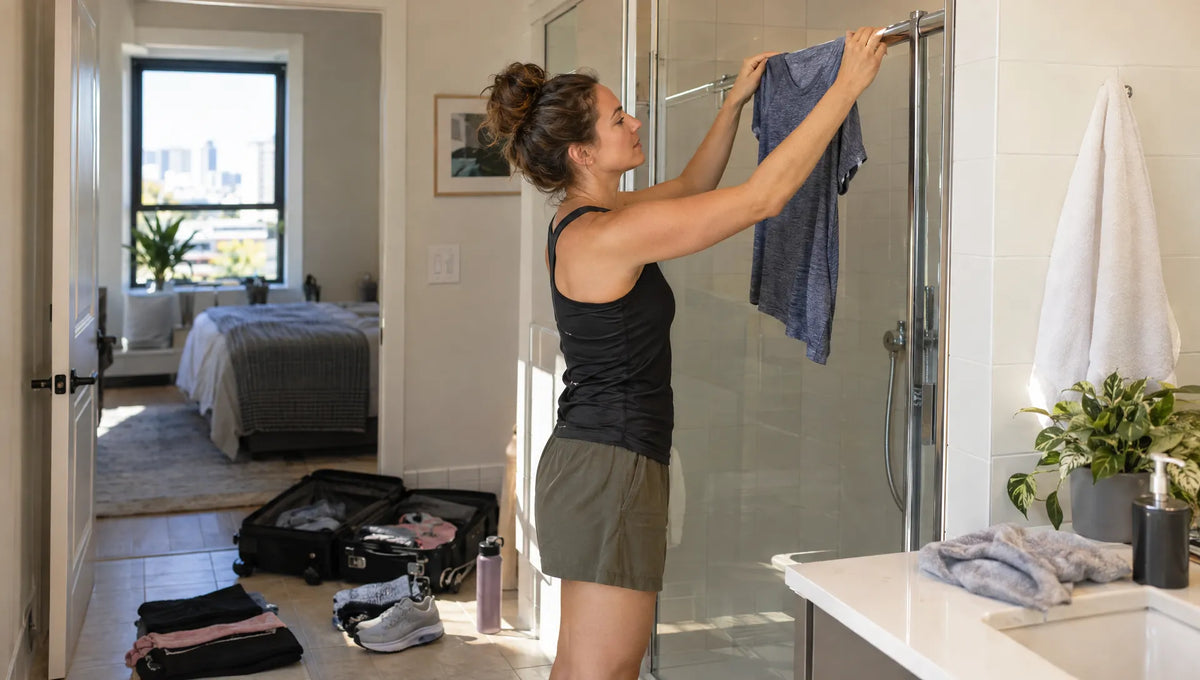
A shirt can move sweat away from your skin yet stay damp for longer than you expect. Another can dry quickly on a clothesline but feel clammy during a workout. Understanding moisture-wicking vs quick-drying fabric helps explain why: one describes how liquid moves through a textile, while the other describes how quickly water evaporates from it.
The two properties often work together, but neither guarantees the other. When choosing workout clothes, underwear or travel layers, look at the finished fabric and garment design rather than treating either label as a promise that you will stay dry.
Moisture-Wicking vs Quick-Drying: The Key Difference
Moisture-wicking fabric transports liquid through small spaces between fibers and yarns. Quick-drying fabric releases water relatively quickly through evaporation under particular conditions.
A well-designed performance shirt usually aims to do both: move sweat away from concentrated wet spots and let that moisture evaporate. However, these are separate processes with different influences.
| Property | What it describes | What it does not guarantee |
|---|---|---|
| Moisture-wicking | Movement and spreading of liquid within or through fabric | Fast evaporation or a completely dry inner surface |
| Quick-drying | How rapidly wet fabric loses water through evaporation | Effective transport of sweat away from skin |
| Absorbency | How readily a material takes up liquid | That the absorbed water will leave quickly |
| Air permeability | How readily air passes through fabric | Wicking, rapid drying or effective moisture-vapor transfer |
Think of these as separate questions to ask about the same garment. Where does sweat go? How much water stays in the fabric? How easily can that water escape?
A single fiber name cannot answer all three.
How Moisture-Wicking Fabric Works
Wicking relies on capillary action, the movement of liquid through narrow spaces. In clothing, those spaces exist between fibers, inside yarns and throughout the fabric structure. Surface chemistry also matters because water must wet those pathways to move through them effectively.
A fabric may spread a small wet patch over a larger area, transport moisture through its thickness or combine both behaviors. Increasing the exposed wet area can help evaporation, provided the surrounding conditions allow it.
But wicking is not automatically one-way. A basic wicking claim does not prove that liquid travels only from the skin-facing surface to the outside. Fabrics engineered for directional transport need more specific evidence.
Why Polyester Can Wick Without Absorbing Much Water
Polyester absorbs little water into the fiber itself, yet a polyester fabric can transport liquid through spaces between its fibers. Yarn shape, knit structure and surface treatments can all contribute.
That distinction explains why “does not absorb much water” and “moves sweat effectively” are not contradictory statements. It also explains why two shirts with identical polyester percentages can perform differently. One may distribute sweat readily, while another lets droplets sit on the surface.
What Makes Fabric Quick-Drying?
Drying speed depends on the garment and its surroundings. A lightweight, open fabric often dries faster than a thick, dense one because there is less material retaining water and more opportunity for evaporation. That is a tendency, not a universal ranking.
Important variables include fabric thickness, the amount of water retained, exposed surface area, airflow, temperature and relative humidity. Pockets, waistbands, padded panels and overlapping seams can remain wet after the main fabric feels dry.
The starting condition matters too. Comparing two fully soaked garments tests something different from adding the same small amount of water to each. A fabric that holds less water after soaking may finish drying sooner even if its evaporation rate is not unusually high.
Humidity Can Limit Both Properties
In humid conditions, water generally evaporates more slowly because the surrounding air already contains substantial moisture. Wicking may spread sweat effectively without making the garment feel dry.
If sweat arrives faster than it can evaporate, even a good performance fabric becomes wet. No textile label overrides that balance.
For a broader look at airflow, fit and fiber choices, our guide to the best fabrics for hot and humid weather explains how those factors work together.
Which Property Matters Most for Your Activity?
The practical answer to moisture-wicking vs quick-drying depends on when dampness causes the most discomfort: while you are sweating, after you stop or when you need to wear the garment again.
| Situation | What to prioritize | What else to check |
|---|---|---|
| Continuous running or cycling | Effective sweat transport plus evaporation | Ventilation, fit and areas covered by equipment |
| Stop-start training | Moisture transport and limited water retention | Whether the garment stays wet during rest periods |
| Hand-washing clothes while traveling | Short drying time after washing | Thick seams, pockets and waistbands |
| Everyday underwear | Comfortable moisture handling | Chafing, coverage, seams and fit |
| Cool-weather layering | Moisture handling across the full clothing system | Whether outer layers allow moisture to escape |
A base layer cannot work independently of everything above it. A shirt that performs well alone may stay wet beneath a poorly ventilated jacket. Our comparison of merino wool and synthetic base layers for running explores that more specific clothing decision.
Everyday Bras and Close-Fitting Garments
The same distinction applies beyond sportswear. If you use hands-free wearable breast pumps from O&K MUBY, assess your bra's moisture handling separately from whether it supports the device securely. Follow the pump's fit instructions first, then consider fabric, seams and drying time for comfort between washes.
Wicking can redistribute perspiration, but it does not make a bra leakproof or replace absorbent nursing pads when needed. Managing sweat and containing a liquid leak are different jobs, even when the garment sits directly against the skin.
How to Evaluate Fabric Claims Before Buying
“Moisture-wicking” and “quick-drying” are useful starting points, but a label alone rarely tells you the test conditions or the size of the benefit. Look for information about the finished fabric, not just a general statement about its main fiber.
Useful details include fabric weight, construction, whether performance depends on a finish and whether testing was repeated after laundering. A drying-time comparison is more meaningful when it identifies the comparison fabric and uses the same conditions for both samples.
Wicking Tests and Drying Tests Measure Different Things
Textile testing distinguishes these properties. AATCC TM195 evaluates liquid moisture management, while AATCC TM201 measures drying rate using a heated plate method. A result from one test should not be treated as proof of performance in the other.
When a brand provides test results, check which property was measured. A water-spreading demonstration can show wetting and transport behavior, but it does not establish how quickly the entire garment dries.
Also inspect the garment itself. A lightweight body fabric may perform well while a dense waistband stays damp. Stretch panels, linings and decorative layers can change the experience considerably.

A Simple At-Home Comparison
You can compare garments you already own without pretending to run a laboratory test. The goal is to identify useful differences under consistent conditions, not assign a certified performance score.
Use clean garments with similar fabric weights where possible. Residual detergent, fabric softener, body oils and previous wear can affect wetting behavior.
- Start with dry fabric: Place comparable areas of each garment flat, away from seams and doubled layers.
- Apply equal amounts of water: Use a dropper or measuring tool rather than an uncontrolled splash.
- Observe spreading: Watch whether the water beads, spreads across the surface or passes through to the other side.
- Compare drying under matching conditions: Expose each sample to the same airflow, temperature and humidity, keeping it away from direct heat.
- Check the whole garment after washing: Compare waistbands, cuffs, pockets and other thick areas as well as the main fabric.
A spreading drop is not proof of one-way sweat transport. Room-temperature water on a flat garment also cannot reproduce movement, skin contact, body heat or the composition of sweat.
Still, this comparison can reveal something useful: whether a “performance” shirt leaves water sitting on its surface or whether a travel garment's waistband is consistently the last part to dry.
Care Can Change Moisture Performance
Moisture-wicking vs quick-drying performance is not necessarily fixed for the life of a garment. Some fabrics rely partly on surface finishes, and residues or wear can change how water interacts with them.
Follow the care label and use the recommended detergent amount. If the manufacturer advises against fabric softener, skip it; deposited coatings can interfere with wetting and transport in some performance textiles. More detergent is not automatically better, since inadequate rinsing can leave residue behind.
Do not use high dryer heat simply because a garment is described as quick-drying. Drying speed during wear says nothing about the heat tolerance of elastic fibers, bonded seams or printed details.
When performance seems worse, check for buildup and care issues before concluding that the fiber itself is unsuitable.
Frequently Asked Questions
Is moisture-wicking better than quick-drying? Neither is universally better. Wicking matters when sweat needs to move and spread during wear. Quick drying matters when retained moisture needs to evaporate. Active clothing often benefits from both.
Does quick-drying mean waterproof? No. Quick-drying fabric is designed to lose water after becoming wet. Waterproof fabric resists water penetration. These are different properties and require different evidence.
Can cotton wick moisture? Yes. Cotton fabrics can take up and spread liquid, but they can also retain substantial water. Wicking ability alone does not make a cotton garment a fast-drying choice.
Is all polyester moisture-wicking? No. Polyester's low moisture absorption does not guarantee effective liquid transport. Yarn design, fabric construction and surface treatment influence whether a polyester garment wets and wicks well.
Will either property prevent sweat stains? Not reliably. Visible marks depend on sweat volume, fabric color, construction, fit and other factors. Spreading moisture may make a wet patch larger even when the fabric is transporting liquid effectively.
Choose for the Job, Not Just the Label
Look for evidence of both liquid transport and drying performance when you need clothing for sustained activity. For travel, pay particular attention to drying after washing and to thick garment components. In either case, construction and fit matter alongside fiber content.
For updates when the store opens, you can join Cavalcade's launch email list.