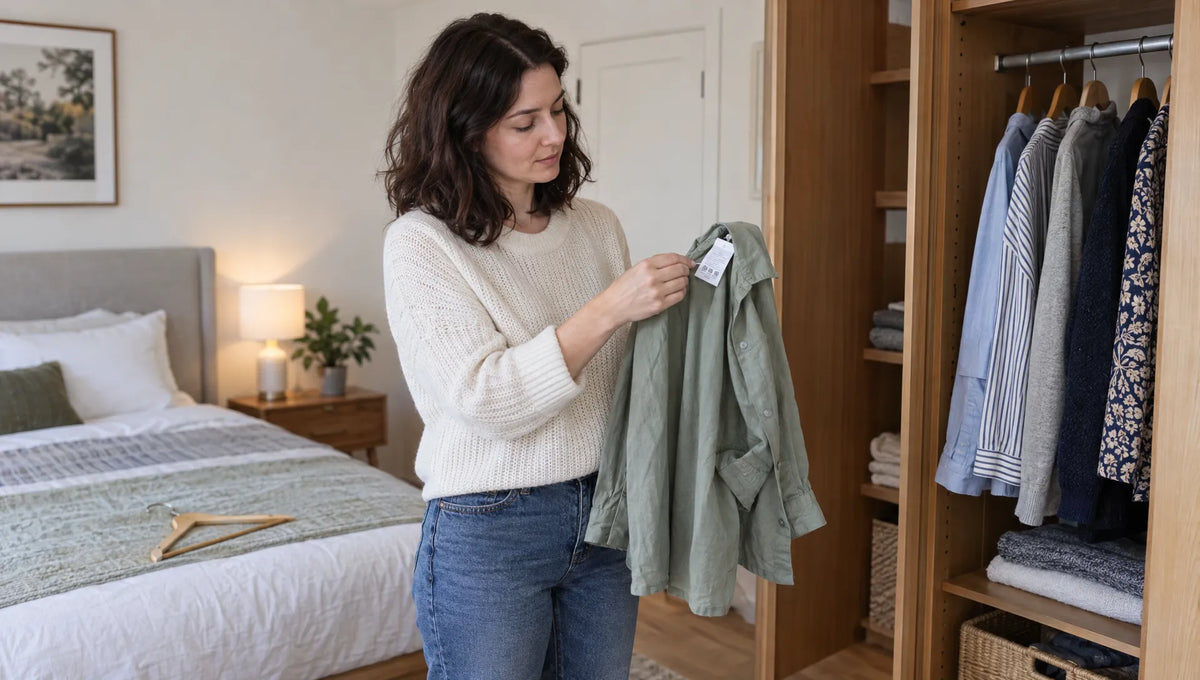
To remove wrinkles from lyocell without damaging it, start with the garment’s care label, then use the gentlest permitted combination of moisture and heat. Steaming can relax light creases, while careful ironing with a pressing cloth can tackle sharper folds. Neither method is right for every lyocell garment, especially when blends, linings or decorative finishes are involved.
The goal is to smooth the fabric without flattening its texture, creating shiny patches or stretching it out of shape. Here is how to choose the right method and know when to stop.
How to remove wrinkles from lyocell safely
The care label takes priority over general fabric advice. Two shirts labeled “lyocell” can need different treatment because their weave, dye, finish and construction differ. A washable, unlined shirt may tolerate a gentle refresh that would be unsuitable for a structured jacket.
Use this table as a starting point, not as permission to override the label.
| Garment condition | First approach to consider | Main precaution |
|---|---|---|
| Light wrinkles after hanging | Gentle steaming, if permitted | Keep the steamer moving and avoid saturating the fabric |
| Sharp folds on a washable shirt | Low-heat ironing from the reverse | Use a clean pressing cloth and test first |
| Slight creases with no tools available | Light misting and reshaping, if washable | Test for water marks and let the garment dry fully |
| Pleats, embellishments or structured construction | Manufacturer guidance or professional care | Heat and moisture may alter the intended shape |
| A label that prohibits ironing | Do not iron | Do not assume a steamer is an acceptable workaround |
If the care instructions are missing or unclear, contact the manufacturer before applying heat. Guessing is particularly risky with a garment that has a coating, lining or bonded detail.
Check the garment before applying heat
Read the full label, not just the fiber percentage
The ironing symbol indicates whether pressing is allowed and the permitted heat level. Follow any written instructions too, including restrictions on steam. If steaming suitability is unclear, check with the manufacturer rather than treating it as automatically safer than ironing.
Blended fabrics need care that suits the entire garment. Stretch fibers, trims and printed areas may be more sensitive than the lyocell itself.
Check for stains before starting. Heat can make some stains harder to remove, and pressing over residue can transfer it onto the iron or neighboring fabric. Clean the garment appropriately first if needed.
Test somewhere hidden
Choose an inside hem or another inconspicuous area. Apply the proposed treatment briefly, then let that spot cool and dry completely before inspecting it.
Look for a change in color, sheen or texture. A patch that appears fine while damp may show a water mark once dry. Stop if the fabric becomes shiny, puckered or distorted.
Also check your equipment. A dirty iron soleplate, mineral deposits or a stained ironing-board cover can mark otherwise clean fabric.
How to steam lyocell without soaking it
A garment steamer can be useful for softening light wrinkles when the care instructions allow it. It is less suited to making crisp edges or removing a heavily set fold in a collar.
Hang the garment with its shape supported
Use a smooth hanger that supports the shoulders without stretching them. Leave enough space for the fabric to hang freely rather than pressing it against a wall or door.
Fill the steamer with the water type recommended by its manufacturer. Let it warm up fully and direct the first bursts away from the garment so you can check for sputtering.
Never steam clothing while wearing it. Keep your hands out of the steam path and avoid holding fabric directly behind the steamer head.
Work in short, moving passes
Start with the gentlest suitable steam setting and the distance recommended for delicate fabrics in your appliance instructions. Test first, then move steadily over a small area. Do not hold the head in one place or press it into the fabric unless both the appliance instructions and garment care guidance permit that approach.
Let the garment hang naturally. If you need to steady the lower edge, support it lightly without pulling the damp fabric taut.
Pause if the fabric becomes wet rather than lightly humid. More steam is not necessarily more effective. Let the area dry before deciding whether it needs another pass, then allow the whole garment to dry and cool before wearing or folding it.
How to iron lyocell without shiny patches
Ironing gives you more control over stubborn folds, but direct contact also makes excessive heat or pressure easier to apply. Start low and work slowly enough to inspect your results, without leaving the iron stationary.
Use the reverse side and a pressing cloth
Turn the garment inside out when its construction allows. Lay one section flat on a clean, padded ironing board, making sure you have not trapped another layer underneath.
Place a clean, smooth, white cotton pressing cloth between the iron and the garment. Avoid textured towels, which can leave an impression. Set the iron to a low temperature that is compatible with the care label, then test a hidden area.
Use light pressure and brief, moving passes. Lift the iron when repositioning instead of dragging the fabric across the board. Work around buttons, zippers and raised seams rather than pressing directly over them.
A pressing cloth provides a buffer, but it does not make excessive heat safe.
Use slight dampness only when appropriate
For a washable garment, a little moisture can help a crease relax. If the fabric has already passed a water-mark test, lightly mist the wrinkled area so it is barely damp, not wet.
Do not increase the iron temperature simply to make its steam function work. Some irons require a hotter setting to produce steam without dripping. If that setting exceeds the garment’s allowance, use the iron without steam and work with carefully controlled dampness instead.
Let each section cool before moving it unnecessarily. This helps avoid putting fresh folds into fabric you have just smoothed.
Stop before a stubborn crease becomes damage
If a fold remains after gentle treatment, check whether you are pressing over a seam allowance or dealing with an intentional crease. Do not keep increasing heat or pressure to force the fabric flat.
Let the area cool and reassess it. A professional cleaner may be the better choice for a persistent crease in a valuable or structured garment.

What to do without an iron or steamer
For slight wrinkles in a washable garment, try a light mist-and-hang refresh. Test clean water on a hidden area first. If it dries without leaving a mark, mist the creased section sparingly, smooth it gently with clean hands and let it hang until completely dry.
This can soften minor creases, but it is unlikely to remove a deep fold. Leave enough drying time before getting dressed; wearing the garment while damp can create new wrinkles where it bends or bunches.
Bathroom humidity is less predictable than a garment steamer. Keep clothing away from shower spray and condensation, and do not rely on this approach for an item that cannot tolerate moisture.
Skip kitchen steam and improvised heat
For a dinner-at-home outfit, refresh your shirt away from food preparation. If you are cooking premium beef from Beef Boutique, keep the garment away from the pan: cooking steam can carry grease and odors, so it is not a substitute for a garment steamer.
Avoid hair straighteners, radiators and direct contact with a hair dryer nozzle. These methods make heat harder to control and can expose one small area to too much of it. Unapproved wrinkle-release sprays can also leave marks or residue, so check compatibility and test before use.
Prevent wrinkles from setting in again
The easiest crease to remove is often the one you prevent during drying. When washing is permitted, avoid leaving the garment compressed in the machine after the cycle ends. Remove it promptly, gently straighten seams and follow the label’s drying instructions.
Do not wring or twist the fabric. If flat drying is required, reshape it on a clean surface. If hanging is permitted, use suitable support so the shoulders and neckline do not stretch under the garment’s weight. Our guide to washing lyocell without shrinking it covers the cleaning and drying steps in more detail.
Once the garment is dry, give it room in the closet. Packing shirts tightly together or folding them under heavier clothing encourages fresh creases. Let a steamed or ironed garment cool fully before putting it away.
Do not use a hot dryer as a shortcut. Tumble drying is an option only when the care label permits it, using the allowed settings and removing the garment promptly.
Frequently asked questions
Is it better to steam or iron lyocell? For light wrinkles, steaming can be a convenient first choice if permitted. Ironing offers more control over sharp folds and edges. The garment’s care instructions, construction and finish determine which method is appropriate.
Can you iron 100% lyocell? Often, but the fiber percentage alone is not enough to decide. Check the ironing symbol and written instructions. If ironing is allowed, begin with low heat, work from the reverse where possible and use a pressing cloth.
Does this advice apply to TENCEL™ Lyocell? The same label-first approach applies, but TENCEL™ branding does not create one universal care routine. Check that the fiber is lyocell rather than modal, then follow the finished garment’s instructions. Our explanation of TENCEL™ versus lyocell clarifies the naming.
Will wrinkles disappear just by hanging the garment? Some light creases may soften, but deep folds often remain. Hanging works best when the fabric is not crowded and has been gently reshaped after an approved wash or refresh.
What should I do if ironing leaves a shiny patch? Stop applying heat and let the area cool. Check it in natural light before doing anything else. Do not scrub it or repeatedly press it, since a surface change caused by heat or pressure may not be reversible. Seek professional advice for a valuable garment.
Keep the next refresh gentle
Use the least treatment that gets the job done: a light refresh for minor creases, careful pressing for sharper folds and professional help when the label or construction calls for it. Extra heat is not a reliable shortcut.
For updates on Cavalcade’s upcoming store launch, you can join the email list on Cavalcade’s homepage.