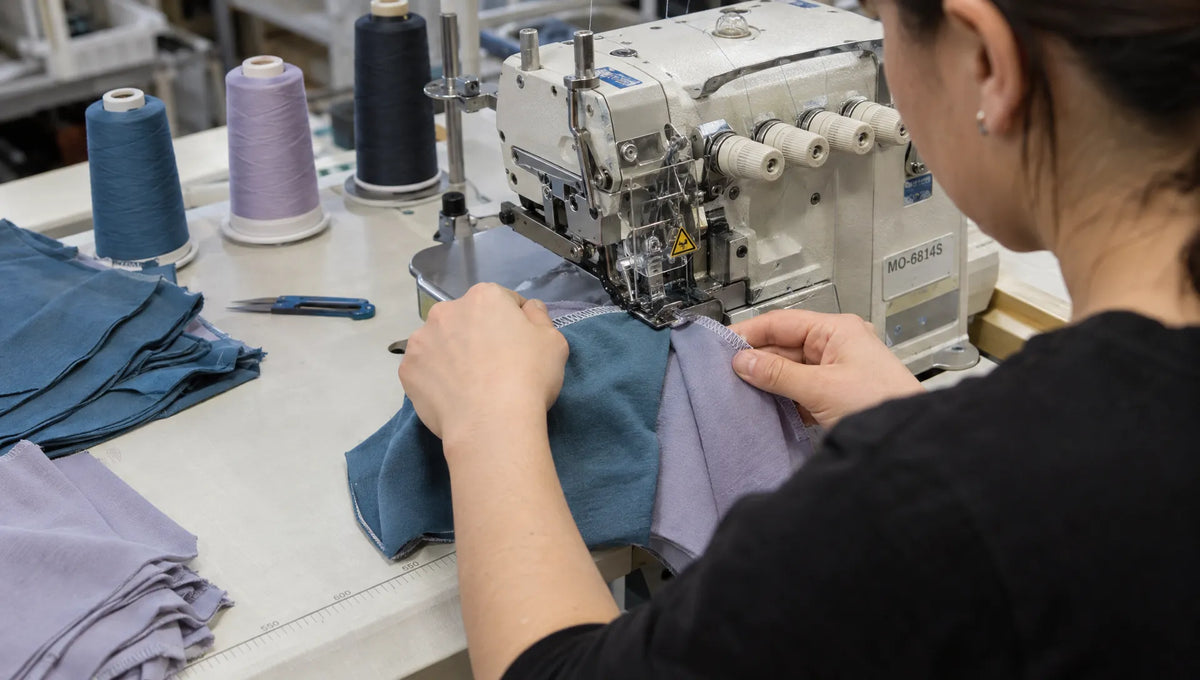
When comparing flatlock vs overlock seams in activewear, focus on what touches your skin, how the join stretches and where it sits during movement. Flatlock construction generally creates a lower-profile join. Overlock construction usually leaves a small seam allowance on the inside, but a well-made overlock seam can still be comfortable, flexible and durable.
Neither construction is automatically better for every workout. A smooth seam in the wrong place can rub, while a carefully positioned overlock seam may go unnoticed. Here is how to distinguish them and choose based on the garment rather than the label.
The key differences at a glance
A seam joins pieces of fabric. Its performance depends on the stitch structure, thread, fabric, sewing tension and placement, not just its name.
| Feature | Flatlock construction | Overlock construction |
|---|---|---|
| How the join is formed | Fabric edges meet or overlap slightly, with stitching spanning the join | Fabric layers are joined with stitches that wrap around their cut edges |
| Interior profile | Generally broad and relatively flat | Usually has a raised seam allowance that rests to one side |
| Skin contact | Less concentrated bulk, though the threads still have texture | A ridge may be noticeable in close-fitting areas |
| Stretch | Can accommodate substantial stretch when correctly specified | Can also accommodate substantial stretch when correctly specified |
| Typical uses | Close-fitting base layers, tights and performance tops | Workout shirts, leggings, shorts and many other knit garments |
| Main thing to inspect | Thread softness, surface texture and join consistency | Ridge thickness, edge finish and seam placement |
These are typical characteristics, not guarantees. Product descriptions sometimes use seam terminology loosely, so photographs of the garment’s interior are especially useful.
What makes a flatlock seam feel different?
In performance apparel, “flatlock” commonly describes a flatseam construction that avoids the conventional inward-standing seam allowance. The fabric edges sit alongside each other or overlap slightly, with threads spanning the join.
Spreading the join over a wider area can reduce the concentrated ridge that presses against skin. That matters in fitted garments, particularly where repeated movement or another layer pushes the seam against the body.
However, flat does not mean texture-free. A wide band of coarse thread can still feel abrasive. Uneven tension, bulky intersections or stiff stitching can also undermine the benefit of a low-profile join.
There is another terminology wrinkle: a serger can produce a flatlock-style seam that is pulled open after sewing. That is not identical to every industrial flatseam construction. For shoppers, the useful distinction is less about identifying the exact machine and more about checking the finished surface.
When weighing flatlock vs overlock seams, run a fingertip across the inside of the garment. Assess the entire join, including the places where several panels meet, rather than judging only the neatest section.
How overlock seams work in activewear
Overlock stitching wraps thread around fabric edges. When used to join garment panels, it usually creates an internal seam allowance: a narrow ridge of fabric and thread that lies toward one side.
This construction is widely used in knit clothing because suitable overlock stitches can join stretchy fabrics while finishing their edges. The presence of an overlock seam is not, by itself, evidence of cheap construction.
A thin, soft allowance in a relaxed workout shirt may be barely noticeable. The same construction can feel more prominent in tight shorts, under a waistband or beneath a loaded backpack strap.
Also distinguish an overlock join from a coverstitch hem. Coverstitching commonly produces parallel lines on the outside of a T-shirt hem with loops underneath. Those visible parallel lines do not establish that the garment’s panel seams are flatlocked.
Look inside the actual side seam or inseam. A hem photograph cannot tell you how the rest of the garment is assembled.
Flatlock vs overlock seams: which suits your workout?
Start with the movements and pressure points involved. Seam placement often matters as much as seam profile.
Running and repetitive movement
For running tights, fitted shorts and close-fitting tops, a low-profile join is worth considering wherever fabric repeatedly moves against skin. Inner thighs, underarms and areas beneath a hydration vest deserve particular attention.
Flatlock can reduce bulk in those locations, but it cannot compensate for shorts that ride up or a shirt that bunches beneath straps. An overlock seam placed away from a friction zone may work better than a flatlock seam positioned directly on it.
For the wider picture, these clothing features that help reduce chafing on long runs address the fit and coverage factors that seam choice alone cannot solve.
Yoga, mobility and strength training
Deep squats and lunges put substantial stretch through leggings, especially around the seat and crotch. Either seam type can work if it stretches with the fabric and recovers without broken stitches or persistent distortion.
During a try-on, check whether the garment restricts movement, pulls at panel intersections or digs into skin. Do not confuse seam stretch with fabric opacity: a seam can remain intact while the surrounding fabric becomes overly sheer.
For looser training shirts and shorts, a neatly finished overlock join may provide all the comfort you need.
Layering, cycling and equipment contact
Base layers sit close to the body, often beneath other garments, so a low-profile seam can be useful where layers press together. Backpack straps and waist belts can make even a small ridge noticeable.
In cycling shorts, assess the pad, its attachment and surrounding seams together. A flatlock label elsewhere on the garment says little about the comfort of the area carrying your weight.
The practical rule is to inspect the seam where pressure and movement occur, not simply count how many flat seams a garment has.
How to inspect a seam before buying
A useful try-on takes more than standing in front of a mirror. Turn the garment inside out first, then examine the construction under normal movement.
- Feel across the join: Check for rough thread, stiff edges, protruding thread ends and bulky intersections.
- Stretch it gently: Apply only the stretch the garment would experience in use. Listen for popping stitches and look for broken threads.
- Let it recover: The join should settle back without obvious lasting distortion or newly broken stitching.
- Move in it: Squat, lunge, raise your arms or mimic your activity. Notice where seams press, shift or scrape.
Some stitch visibility under tension can be normal, depending on the construction. A gap that exposes an unjoined section, a snapped thread or a seam that starts unraveling is a different concern.
Fit also changes the comparison. An undersized garment can overload an otherwise suitable seam. Excess fabric can fold and rub even when the stitching itself is smooth. Compare garments in a size that lets you move normally.

What to look for when shopping online
Ask for close-up photographs of both sides of the seam, especially at the inseam, underarm and waistband intersections. “Flat seams” is less informative than a clear image showing how the panels meet.
Interactive product views can also help you understand panel layout. Studios such as The New Face create immersive commerce experiences and product configurators, formats that can reveal additional angles when construction details are accurately represented. Rendered views still cannot establish thread softness or how a seam feels against skin.
Use those visuals alongside photographs of the actual garment, construction information and the retailer’s return policy. If the description only names the seam type, you still do not know its thickness, thread feel or behavior in motion.
What seam type cannot tell you
The flatlock vs overlock seams comparison answers a construction question. It does not settle every question about activewear performance.
Moisture management comes primarily from the fabric and garment design. A flatter join does not automatically make a shirt wick sweat or dry faster. Understanding moisture-wicking versus quick-drying fabric helps separate those properties from seam comfort.
Likewise, neither seam name guarantees long-term durability. Thread choice, stitch formation, sewing consistency and the strain placed on the garment all affect how a join holds up. A poorly executed flatlock seam can fail sooner than a well-executed overlock seam.
Compression is another separate consideration. It comes from the garment’s fabric, dimensions and panel design, not from the presence of flatlock stitching alone.
For buying decisions, prioritize fit and the finished construction. Treat the seam label as useful information, not a quality certification.
Caring for seams without damaging the fabric
Follow the garment’s care label rather than choosing a wash routine based on its seam type. The fabric, elastic components, prints and trims may have different care requirements.
Avoid pulling a garment off by one small seam or forcing it past its comfortable stretch range. When laundering, keep exposed hook-and-loop fasteners away from delicate knits and stitching. Use a laundry bag when the care instructions recommend one.
If you notice a loose thread, do not pull it to see what happens. Check whether it is a harmless tail or part of an unraveling join. A repair professional can assess a damaged structural seam before further wear makes the opening larger.
Frequently asked questions
Are flatlock seams always better for preventing chafing? No. Their lower profile can help, but thread texture, seam placement, moisture and fit still matter. A smooth overlock seam away from a friction zone may be more comfortable than a rough flatlock seam directly against it.
Are overlock seams stretchy enough for leggings? They can be. A correctly specified and sewn overlock seam can stretch with knit fabric. Check the finished garment during normal movement rather than assuming the stitch name guarantees or rules out flexibility.
Which is stronger, flatlock or overlock? Neither is universally stronger. Seam strength depends on the construction, thread, fabric and sewing quality. Both can perform well when matched to the garment’s intended use.
Does “seamless” mean the same thing as flatlock? No. Seamless garments use knitting methods that reduce or eliminate some panel joins, although they may still contain seams elsewhere. Flatlock describes a way of joining fabric, not the absence of joins.
Stay updated on Cavalcade
For store-opening updates, join the email list on Cavalcade’s launch page. When comparing activewear, keep checking the inside construction as carefully as the fabric and fit.